
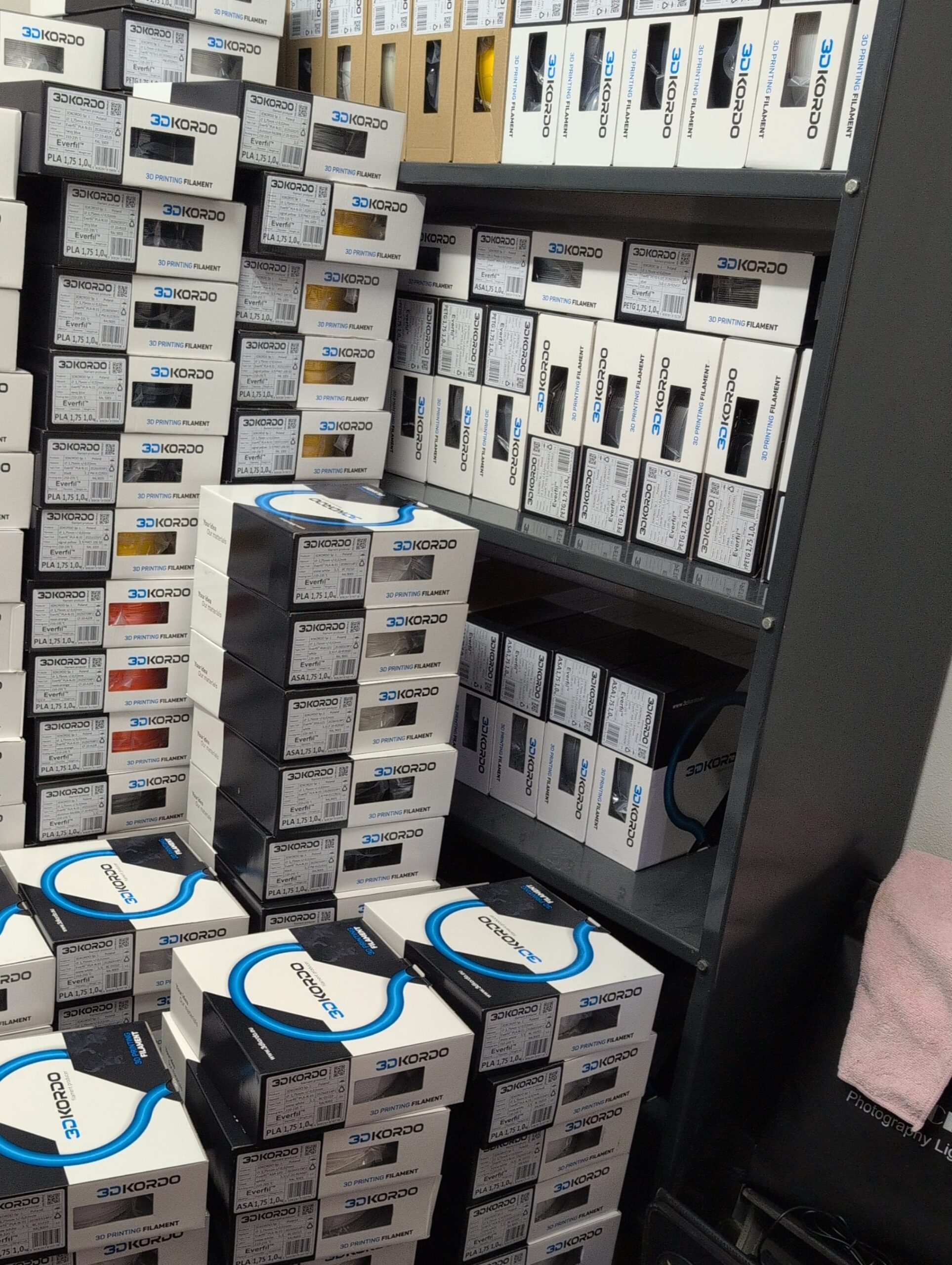
These four materials cover 95% of FDM printing needs. Picking the right one isn’t complicated once you understand what each is built for.
PLA – The Everyday Workhorse
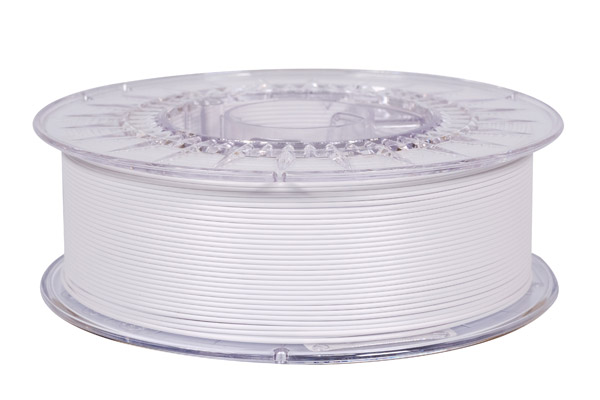
PLA (polylactic acid) is biodegradable, derived from plant starch, and the easiest FDM material to print. Low thermal expansion means it holds its shape reliably on the bed, and it needs no heated enclosure.
| Parameter | Value |
|---|---|
| Nozzle temperature | 190–220°C |
| Bed temperature | 20–60°C (no heated bed required) |
| Print speed | 40–100 mm/s |
| Diameter tolerance | ±0.02 mm |
| Density | 1.24 g/cm³ (typical) |
| Service temperature | ~60°C |
| UV resistance | Poor |
Available as spool: Aluminium, Black, Carmine Red, Green, Navy Blue, Neon Orange, Signal Yellow, Snow White (8 colors).
Best for: prototypes, visual models, figurines, educational prints, anything that lives indoors without structural load.
Where it fails: Leave a PLA print on a car dashboard in summer and it warps. Use it for a bracket under sustained tension and it creeps slowly out of shape. Put it outside for a year and it turns brittle. PLA is an excellent starting point and a poor finish line for anything functional.
PETG – The Sweet Spot
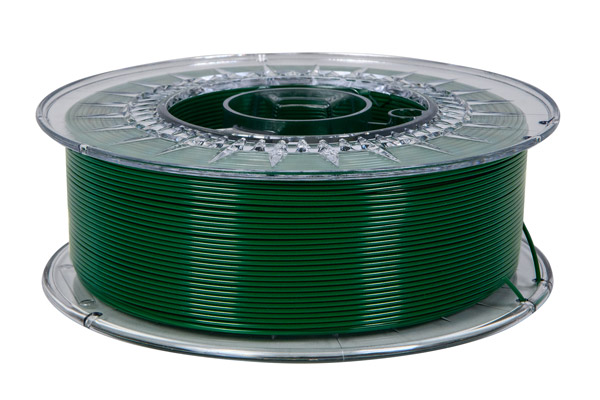
PETG (polyethylene terephthalate glycol) combines much of PLA’s ease of printing with meaningfully better mechanical and thermal properties. The glycol modification makes it more impact-resistant than standard PET and far easier to print than ABS.
| Parameter | Value |
|---|---|
| Nozzle temperature | 220–250°C |
| Bed temperature | 60–80°C |
| Print speed | 40–80 mm/s |
| Diameter tolerance | ±0.02 mm |
| Density | 1.27 g/cm³ (typical) |
| Service temperature | ~80°C |
| UV resistance | Fair |
| Food-safe | Yes |
Available as spool: Black, Blue, Green, Orange, Red, Silver, White, Yellow (8 colors).
Best for: functional household parts, brackets, mounts, containers, camera rigs, enclosures — anything that needs to survive moderate heat or occasional moisture.
PETG is the most forgiving upgrade from PLA. If you can print PLA, you can print PETG with minor settings adjustments. The main gotcha is stringing — PETG oozes more at travel moves and needs careful retraction tuning.
ASA – The Outdoor Champion
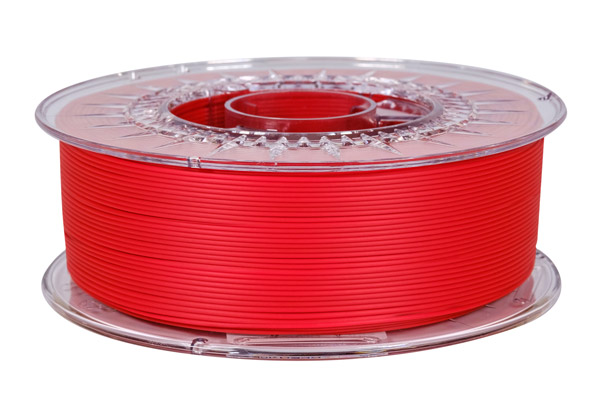
ASA (acrylonitrile styrene acrylate) is purpose-built for outdoor use. Chemically similar to ABS but with an acrylate rubber component that dramatically improves UV stability — the same chemistry used in outdoor signage and automotive trim.
| Parameter | Value |
|---|---|
| Nozzle temperature | 230–250°C |
| Bed temperature | 80–110°C |
| Print speed | 40–70 mm/s |
| Diameter tolerance | ±0.02 mm |
| Density | 1.06 g/cm³ |
| Vicat softening point | 100–105°C |
| UV resistance | Excellent |
| Acetone-smoothable | Yes |
Available as spool: Black, Blue, Green, Orange, Red, Silver, White, Yellow (8 colors, also available in 2.3 kg bulk spools).
Best for: garden brackets, sensor mounts, RC car bodies, automotive trim, irrigation parts, outdoor signage, anything mounted outside.
The printing tradeoff: ASA needs heat. Without an enclosure, large flat sections warp as they cool unevenly. Small parts print open-air; anything over ~100 mm benefits from enclosure. Ventilate your print space — ASA off-gasses more than PLA or PETG at printing temperatures.
Why Don’t We Stock ABS?
Because ASA makes it redundant.
ABS and ASA share the same printing temperature range, the same acetone-smoothing trick, and similar mechanical strength. The difference is what happens after the part leaves the printer: ABS has essentially no UV resistance and degrades visibly within a season outdoors. ASA was developed specifically to fix that — the acrylate component is UV-stable by design, not by coating.
Everything you’d reach for ABS to do — smooth surfaces, high service temperature, solvent bonding, tough functional parts — ASA handles at least as well. We stock ASA instead of ABS because there’s no scenario where ABS is the better choice for our customers.
PCTG – The Upgraded PETG
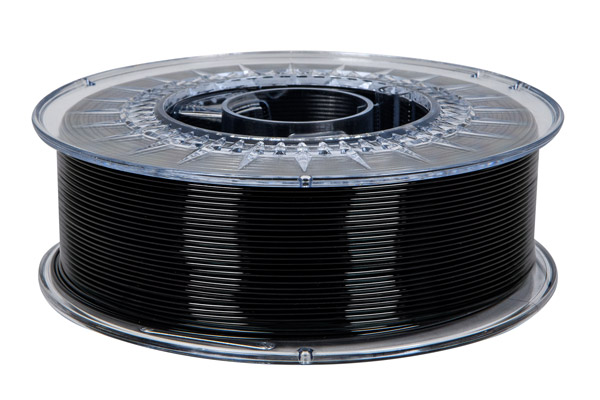
PCTG is a copolyester closely related to PETG but with better impact toughness and stronger inter-layer adhesion. Less common than the others, but it outperforms PETG noticeably in demanding mechanical applications.
| Parameter | Value |
|---|---|
| Nozzle temperature | 230–250°C |
| Bed temperature | 70–90°C |
| Print speed | 30–60 mm/s |
| Diameter tolerance | ±0.02 mm |
| Density | 1.26 g/cm³ |
| Glass transition | 85°C |
| UV resistance | Good |
| BPA-free | Yes |
| Food-contact safe | Yes |
Available as spool: Black, White (2 colors).
Best for: high-cycle mechanical parts, transparent enclosures, food-contact applications, parts where PETG’s ease of printing isn’t quite enough toughness.
The main reason to reach for PCTG over PETG: impact resistance. Parts that take repeated shocks hold up significantly better. Also worth considering when you need transparency — PCTG prints clearer with less internal haze than PETG.
Quick Comparison
| Material | Density | Service Temp | UV Resistance | Spool Colors | Print Difficulty | Best Use |
|---|---|---|---|---|---|---|
| PLA | 1.24 g/cm³ | ~60°C | Poor | 8 | Easy | Prototypes, decor, figurines |
| PETG | 1.27 g/cm³ | ~80°C | Fair | 8 | Easy–Medium | Functional indoor parts |
| ASA | 1.06 g/cm³ | 100–105°C | Excellent | 8 | Medium | Outdoor, automotive, RC |
| PCTG | 1.26 g/cm³ | ~85°C (Tg) | Good | 2 | Easy–Medium | Tough mechanical, transparent |
How to Choose
Start with PLA for anything decorative or prototype. Use PETG as your default functional material. Reach for ASA when the part goes outside or near a heat source. Use PCTG when you need PETG-level printability with better impact resistance or transparency.
If you’re still unsure: PETG is the safest bet for anything functional. It costs CHF 2.70/kg more than PLA and saves you a reprint when the part actually needs to work.
What If I Need Something Flexible, or With Specific Constraints?
PLA, PETG, ASA, and PCTG cover most applications — but not all. Flexible materials (TPU, TPE), high-temperature engineering grades (PA, PC, PEI), or specialty composites (carbon-filled, metal-filled) fall outside our current core stock.
We’re open to expanding our range. When we add a new material, we want to make sure it genuinely meets a real need — not just pad the shelf. If you have a project with specific material requirements, get in touch and tell us what you’re trying to achieve. We’ll either point you to the right existing option or consider stocking what makes sense.